For historical / review purposes
The rest of this page preserves the evidence and discussion prepared for the 17 September 2026 decision. References below to a forthcoming vote, candidate dates, or requests for input describe that pre-vote context, not a new invitation to vote. The wildfire alert record continues to be updated, with its current coverage stated alongside the charts.
📊 The attendee survey has closed. 948 people told us which weeks in 2027 they could come. The headline chart is in section 2.2; the full analysis and the anonymised data are on the survey results page →
Pre-vote information-pack summary
- Decision to be taken — should Elsewhere remain in the established early-July window or move?
- Who decides — asociados (association members).
- When — 17 September 2026.
- How — ranked vote between the candidate weeks listed below (see how the ranking method works).
- Board opinion — each board member’s for/against view on the viability of every shortlisted week is in section 2.6.
Important disclaimer: the highest-ranked option may still not be feasible if the relevant authorities do not approve the dates — for example due to environmental or bird-nesting restrictions. The authority’s response is currently expected after the vote, so voters should understand that limitation before looking at the options.
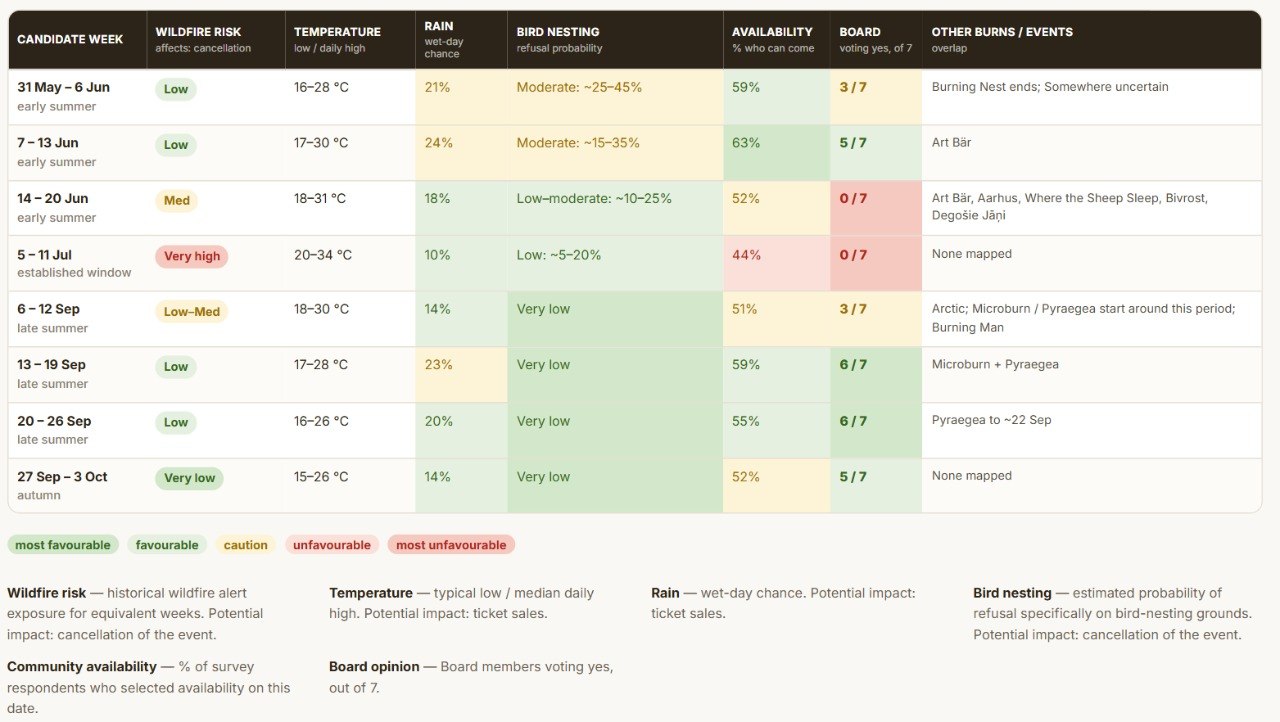
The table below gives a week-by-week overview of the candidate windows being considered for 2027, using data from 2025: historical wildfire-risk levels, temperatures, rain and wet days, bird-nesting refusal probability, community availability, board opinion, and overlaps with other European burns or events in the Monegros desert. The scale for each column is explained at the bottom of the table. Click the image to see it full size, or open the interactive version of this table (available in English, Spanish, French, German and Italian).
1. What is actually being decided
The 2026 event ran 7–12 July. Without a decision to the contrary, 2027 would sit in the equivalent early-July window — the working assumption in the planning material is 5–11 July 2027.
The question going to the General Assembly is whether to keep that slot or move to a different window. It is a members’ decision: each member of the association has one vote. The deciding vote is planned for Thursday 17 September 2026, online, and keeping the current dates will be a real option on the ballot.
2. Criteria for date selection
The evidence bearing directly on which window to choose: the wildfire record, heat and rain, the calendar of other European burns, and environmental constraints.
2.1 Wildfire evidence: what has actually happened
This is the main operational reason a date change is being considered. The table below shows the official daily Nivel de Alerta de Peligro de Incendios Forestales (NAPIF) for the site’s alert zone, week by week.
The established site is in Castejón de Monegros, assigned by the Gobierno de Aragón to the Muelas del Ebro–Alcubierre meteoalerta zone. When Roja Plus was issued by comarca in July 2026, the relevant area was Los Monegros.
The verified Roja Plus record comprises four declaration episodes. There was one declaration in 2025, covering 16–18 August. In 2026 there were three separate declarations covering five days: 26–28 June during build, then 10 July during the event and 12 July during strike.
Ordinary Red also caused real disruption before Roja Plus was first used. The site zone was Red from 29 June to 3 July 2025, immediately before and during the opening of a similar event in 2025. The event activated its Red Alert protocol, including temporary movement restrictions. That was Red, not Red Plus, but it belongs in the operational history.
Latest update, 9–18 September 2026: the site zone recorded two Red days (9 and 15 September), four Orange days, and four Yellow days, with no new Red Plus declaration. This follows four consecutive Red days on 5–8 September. The tables, charts, totals, and build/event/strike estimates below include the official daily reports through 18 September.
Official report: 29 Jun 2025 Official report: 16–18 Aug 2025 Official report: 26–28 Jun 2026 Official report: 10 Jul 2026 Official report: 12 Jul 2026
2.1.1 Daily alert levels in each candidate week
Did the alert criteria change?
One important classification change did occur: Roja Plus was added for the 2023 campaign to identify exceptional episodes of extreme danger. That means Red Plus cannot be compared with years before 2023. However, this page starts in 2023, and the Gobierno de Aragón does not identify any subsequent change to the Green / Yellow / Orange / Red thresholds that would explain the sharp rise within this 2023–2026 series. The March 2026 decree changed the legal consequences of Roja Plus for authorised events, not the meteorological calculation of NAPIF.
What appears to drive the levels?
NAPIF is a weather-and-fuel-danger assessment, based on the Canadian Forest Weather Index and adjusted for Aragón using factors including overnight humidity recovery, fire-type analysis, cloud, thunderstorm risk and atmospheric stability. The available evidence therefore supports reading the increase primarily as worse assessed fire-weather and fuel conditions, rather than as an artefact of newly lowered alert thresholds. It does not, by itself, prove how much of the four-year change is attributable to long-term climate change rather than ordinary year-to-year weather variability, drought and fuel condition.
Gobierno de Aragón: levels and how NAPIF is calculated Decreto 22/2026: legal consequences
Daily alert levels by week
Loading daily alert history…
Alert-day totals by year
Loading annual alert totals…
Each year cell in the underlying table is Green / Yellow / Orange / Red / Red Plus. Hover or focus a cell containing Red or Red Plus to see the exact dates. The 2026 column stops on 18 September 2026; future dates are not filled with assumptions.
Show data
Coverage limitation: the archive does not provide a complete, consistently daily series before 1 June across all four years. May is therefore marked n/a, not zero-risk; some extraordinary reports were published before June. Future 2026 dates are also n/a because their reports do not exist yet. Hover or focus either abbreviation to see which reason applies.
How the site level is read: each classification comes from the colour of the Muelas del Ebro–Alcubierre polygon on that day’s official map. The report prose often lists only zones at the highest level, so it is not sufficient by itself to distinguish Green from Yellow in every area.
What the final column means: each candidate week is mapped onto the same calendar dates in 2026. The column then counts Red and Red Plus days from 21 days before that week through 10 days after it — a 38-day window representing build, the event, and strike. Where part of that window falls after 18 September, Est fills the missing days with the alerts recorded on the same calendar dates in 2025. Hover or focus a value to see the exact date range and how the estimate was made. This is a historical stress test, not a forecast for 2027.
Gobierno de Aragón NAPIF archive Download daily site series (CSV) Download weekly counts (CSV) Official municipality-to-zone assignment
| Candidate week | 2023 G/Y/O/R/R+ |
2024 G/Y/O/R/R+ |
2025 G/Y/O/R/R+ |
2026 to 4 Sep G/Y/O/R/R+ |
2026 Red/R+ days full 38-day operating window |
|---|---|---|---|---|---|
| Loading the cited daily alert series… | |||||
This does not prove a particular cancellation probability for 2027. It does substantiate why the authorities’ concern is no longer hypothetical, and why build and strike cannot be excluded from the comparison.
2.1.2 Recorded fires and area burned
The official IAEST series gives annual fire counts and forest area affected. It is useful context, but it must not be confused with the alert table: ignition count, hectares burned and legal suspension risk are different measures.
| Year | Aragón | Huesca province | Los Monegros |
|---|---|---|---|
| 2023 | 352 fires / 1,549.13 ha | 102 / 32.77 ha | 13 / 6.99 ha |
| 2024 (provisional) | 276 / 1,441.76 ha | 67 / 247.67 ha | 11 / 3.27 ha |
| 2025 (provisional) | 269 / 353.26 ha | 97 / 186.70 ha | 13 / 21.40 ha |
| 2026 (partial to 14 June) | 193 / 238.22 ha | 72 / 87.72 ha | n/a |
2026 note: the latest official statistical bulletin stops on 14 June and does not publish a comparable Los Monegros subtotal. It predates the later June and July alert episodes.
A later official episode bulletin adds an area-burned update through 26 July 2026. Across Aragón it provisionally records 16,500 ha of forest land burned and 28,000 ha in total (forest and agricultural land). It does not publish a revised incident count or geographic subtotals comparable with the table above.
The bulletin lists the 30 June Leciñena fire in Los Monegros among the year’s largest incidents: provisionally 2,069 forest ha and 3,100 ha total. This is one named fire, not a comarca total.
Why there is no candidate-week fire-count table
The daily NAPIF reports label their incident list provisional, can repeat an incident across several days as its status or area changes, and do not replace the final IAEST statistical series. Counting those lines as independent fires would manufacture precision. The daily alert table above is complete enough for a week-by-week comparison; final fire counts are presented only at the annual geographic levels for which the official statistical source supports them.
IAEST: fires and forest area by municipality, comarca and province Official 2026 statistics through 14 June Official 12 Jun 2026 incident report
2.2 Date availability of the community
The attendee survey ran from 23 August to 4 September 2026 and received 948 responses (477 identified through a personal Humans link, 447 anonymous), with 378 written comments. For each candidate week, respondents said whether they could come to at least one part of the event. Identified and anonymous respondents are shown separately because they do not always agree; the label is the overall share.
Share of respondents who could come to at least one part of the event, by week
Identified (n=477) Anonymous (n=447) Label: all respondents in the group (n=948). Hover a row for exact numbers.
378 respondents also wrote a comment. The themes, with the share of those 378 comments that touched on each (a comment can carry more than one):
| Theme | Share |
|---|---|
| Clashes with other burns and events | 19% |
| Heat as a health and safety hazard | 19% |
| Wildfire risk and fear of cancellation | 16% |
| Preference for September/October | 16% |
| Work makes summer the only free window (or the busiest one) | 16% |
| Preference for May/June | 15% |
| General support for moving the date | 11% |
| Bound by the school calendar | 11% |
| The heat is the point | 10% |
| Gratitude and trust in the organisers | 8% |
| Fear of cold nights in shoulder season | 6% |
| Rain, mud and build/strike practicalities | 6% |
| I'll come whenever | 5% |
| Critique of the survey itself | 5% |
| Burning Man as the parent event | 3% |
| Change the site, not just the date | 3% |
| Keep the current July dates | 3% |
| Bird nesting and environmental considerations | 2% |
| Adapt the site instead of (or alongside) moving dates | 1% |
Full survey results → — availability by group and by language, who would be lost and gained against the current dates, the comments in their own words, and the anonymised data to download.
2.3 Candidate windows: heat and rain
The tables below are calculated from daily data for the established-site coordinate, 41.7005615, -0.1363139. They compare matching calendar weeks historically; they are not forecasts for 2027.
Method and sources
Each candidate week is compared with the same seven calendar dates in the twenty complete years 2006–2025. “Typical” is the median daily value; a “hot day” is the 95th percentile daily maximum; a “cool night” is the 5th percentile daily minimum. A wet day has at least 1 mm precipitation. “Weeks with rain” is the proportion of the twenty matching weeks with at least 1 mm total rain; the wet-week figure is the 90th percentile of those twenty weekly totals.
The source is the Open-Meteo Historical Weather API, using its ERA5 / ERA5-Land best-match historical series. Reanalysis is appropriate for consistent comparison at an exact rural coordinate, but it is gridded data rather than a rain gauge on the festival site.
2.2.1 Temperature
Historical temperature pattern by candidate week
Loading temperature chart…
Show data
| Week | Typical high | Hot day 95th percentile |
Typical low | Cool night 5th percentile |
Days ≥35°C mean per week |
Nights ≥20°C mean per week |
|---|---|---|---|---|---|---|
| Loading the cited climate series… | ||||||
2.2.2 Rain
Historical rain pattern by candidate week
Loading rain chart…
Show data
| Week | Wet-day chance | Historical weeks with rain | Mean weekly rain | High-rain week 90th-percentile total |
|---|---|---|---|---|
| Loading the cited climate series… | ||||
For the current 5–11 July slot, the recent historical median daily high is 34.2°C, with about 2.6 days at or above 35°C and 3.9 nights at or above 20°C in a typical matching week. The mean weekly rain is 6.4 mm, and 65% of matching years had at least 1 mm during the week. May weeks are cooler but not uniformly wetter every week; late September and October have lower heat exposure but materially higher upper-tail weekly rain totals.
Constraints the table does not capture
- May and early June: local advice is that this overlaps peak harvest activity, with tractors and harvesters using the same access roads. The climate table supplies the rain evidence; the harvest constraint is operational local evidence and has not yet been quantified.
- Late September and October: the weekly reanalysis shows lower heat but a higher upper tail for accumulated rain. At a site defined by converging barrancos, the consequence of a concentrated storm is a hydraulic question for CHE; weekly averages cannot resolve flash-flood behaviour at the site.
- School and academic calendars: moving further into the academic year has been raised as a constraint for participants with children, and for teachers and students. This has not been quantified.
- Build and strike: the event week is not the whole footprint. Build begins roughly three weeks before and strike ends roughly ten days after, so any window drags a five-to-six week envelope behind it — which is what the authorities assess, and what a June event would push into May.
2.4 Other European burns
Part of the work in progress is contacting other events directly — both to understand how a move would affect their communities and ours, and because several of them have moved their own dates in the past and can say what happened. The responses will go into the information pack; this table is only the calendar as currently mapped.
| Candidate week | Other European burns or events in the Monegros desert |
|---|---|
| 31 May–6 Jun | Burning Nest ends; Somewhere uncertain |
| 7–13 Jun | Art Bär |
| 14–20 Jun | Art Bär, Aarhus, Where the Sheep Sleep, Bivrost, Degošie Jāņi |
| 5–11 Jul | None mapped |
| 6–12 Sep | Arctic; Microburn / Pyraegea start around this period; Burning Man |
| 13–19 Sep | Microburn + Pyraegea |
| 20–26 Sep | Pyraegea to ~22 Sep |
| 27 Sep–3 Oct | None mapped |
Two things this table cannot tell you, and which the outreach is meant to: how much attendance actually overlaps between events, and how the communities that have moved dates before were affected when they did.
2.5 Bird nesting and environmental constraints
Fire is not the only regulated axis. The area holds protected species — notably the lesser kestrel (cernícalo primilla) and Dupont’s lark (alondra ricotí) — whose breeding seasons fall across spring and early summer, and the permitting authority holds a discretionary power to condition or restrict organised events in designated critical areas where they could affect reproduction.
The practical consequence is that moving earlier does not simply trade heat for safety: April to June is the most sensitive part of the wildlife calendar as well as being inside the fire season. We are currently working through the nesting schedules and the mapped protected-area overlaps for both the established site and the proposed new site, which have different exposures and cannot be assumed to behave the same way.
This work is preliminary and unverified. It will form part of the information pack once it is firmer.
- INAGA and bird-nesting periods in Monegros — the current draft research note, with the mapped distances to protected areas for both sites
2.6 Board opinion
At its meeting of 7 September 2026 the board fixed the eight-week shortlist that goes to the vote, and committed to publishing how each board member sees each week. The four members present recorded their positions in the meeting; the others sent theirs in writing over the following two days. Michelle has not yet recorded a position, so the counts below are out of seven.
What these votes mean: each board member was asked whether, on the information available, the event would be viable in a given week — commercial viability, cancellation and wildfire risk, permit risk — not which week they would personally prefer. Several members said they will attend whichever week wins, and more than one voted for weeks they would not choose for themselves. No week is a board recommendation; the current week is on the ballot as the status quo. Every week remains subject to the INAGA (bird-nesting) permit decision.
Votes by board member
| Week | Victor | Chris | Pablo | Daniel | Ward | Peter | Ben | For |
|---|---|---|---|---|---|---|---|---|
| 31 May–6 Jun | ✗ | ✗ | ✓ | ✗ | ✗ | ✓ | ✓ | 3/7 |
| 7–13 Jun | ✗ | ✓ | ✓ | ✓ | ✗ | ✓ | ✓ | 5/7 |
| 14–20 Jun | ✗ | ✗ leaning | ✗ | ✗ | ✗ | ✗ | ✗ | 0/7 |
| 5–11 Jul (current) | ✗ | ✗ | ✗ | ✗ | ✗ | ✗ | ✗ | 0/7 |
| 6–12 Sep | ✗ | ✗ | ✗ | ✓ tentative | ✓ | ✗ | ✓ | 3/7 |
| 13–19 Sep | ✓ | ✓ | ✓ | ✓ | ✓ | ✗ | ✓ | 6/7 |
| 20–26 Sep | ✓ | ✓ | ✓ | ✓ | ✗ | ✓ | ✓ | 6/7 |
| 27 Sep–3 Oct | ✓ | ✓ | ✓ reserv. | ✓ reserv. | ✗ | ✓ | ✗ | 5/7 |
Reasons given, week by week
A summary of the arguments board members gave for and against each week, drawn from the minutes and the written positions sent afterwards. The name in brackets is who raised the point; where several members made the same point, only the count is given.
| Arguments for | Arguments against |
|---|---|
| 31 May – 6 June 3 of 7 for | |
| No specific risk identified; people already travel to Midburn and AfricaBurn in this period, and the Burning Nest overlap (it ends the day before) is not disqualifying (Pablo). Weather window acceptable, subject to INAGA (Ben). Late May / early June is a good window (Peter). | Too close to the end of the working year for an event with a long build and strike; risk of low attendance (Victor, Chris). Bird-nesting season adds permit uncertainty (Victor, Daniel, Ward). More rain, and local-authority advice that late May is a heavy farm-machinery period (Daniel). Academic calendars (Ward). Would prefer no overlap with the UK burn (Peter, who still voted for). |
| 7 – 13 June 5 of 7 for | |
| The most-selected week in the survey (67% could attend), so commercially viable (Chris, Daniel). Best week for build and strike availability; good combination of every factor, with better temperatures (Pablo). No direct clash with another event (Chris). No red-alert fire days in this week this year (Daniel). Weather window acceptable, subject to INAGA (Ben). Early June good (Peter). | Same bird-nesting permit risk and end-of-working-year concern as the week before (Victor). Birds, and students and teachers not yet free (Ward). |
| 14 – 20 June 0 of 7 for | |
| Decently viable commercially (Chris, who nonetheless leaned against). Nobody voted for it. | Lower survey support (56%) than 7–13 June (Pablo, Daniel). Edging into the fire season: had the event been on this week this year there would have been an evacuation near the end of strike (Daniel); hotter, and in the projections it only gets worse (Victor, Pablo, Chris). Maximum calendar congestion with other events (Ben). Bird-nesting season (Victor, Ward). |
| 5 – 11 July (current week) 0 of 7 for | |
| None. It is on the ballot as the status quo so that members can express a preference for no change. | High probability that a permit for this week would not be granted at all, and if granted the event would very likely be suspended; this year’s leniency from the authorities cannot be assumed to repeat (Daniel, Victor). Not worth the effort only to face evacuating 3,000 people (Daniel). Heat has been unbearable for some years; people have stopped coming for that reason alone (Victor, Ben). Inside the red-plus alert period (Ward). |
| 6 – 12 September 3 of 7 for | |
| Avoids the red-plus fire-alert periods and the bird-nesting season, and finishes before most academic years start (Ward — his first choice). Weather window acceptable; the Burning Man overlap makes it less preferable but still viable (Ben). Nowhere’s community is price-conscious and only a small minority can afford Burning Man, so the overlap matters less than it looks (Daniel). | Overlaps with Burning Man, which ends on 6 September — don’t start the move with that conflict; if the association wants to test the overlap it can do so later once the impact is understood (Chris, Pablo, Peter). Many community members would still be on holiday or just back, and planning an event straight after that period is uncomfortable (Victor). Slightly more fire risk than the later September weeks (Daniel). |
| 13 – 19 September 6 of 7 for | |
| No clear risk of any kind; far enough from the holidays; high survey support (62%, the September peak) (Victor, Chris, Daniel). Lower bird-nesting risk than the June weeks, so less likely to be moved by the permit decision (Daniel, Ward). Doable for people who do both events, and the association would learn how much the Burning Man overlap matters (Pablo). Weather window acceptable (Ben). Before most academic years start (Ward). | Too close after Burning Man — with it ending on 6 September there is no gap between the two (Peter). Temperatures start to come down, which some will see as a loss (Daniel, who still voted for). |
| 20 – 26 September 6 of 7 for | |
| Same reasoning as 13–19 September (Victor, Chris, Daniel). Two weeks after Burning Man, so a real gap (Peter). Cooler nights (Pablo). Lower bird-nesting risk (Daniel). Weather window acceptable (Ben). | Some academic years start mid- or late September (Ward). |
| 27 September – 3 October 5 of 7 for | |
| Late enough that people can do their summer festivals and come to a burn after a few weeks of work; the best week for the bird permit; cooler nights and longer mornings without heat (Victor — his favourite). Viable, so let the members decide; it will simply be ranked down if they don’t want it (Pablo, Daniel). Clear of Burning Man (Peter). | Weather becoming too wet and cold (Ben). Feels late, and the survey numbers are slightly worse than the other September weeks (55%), with core members less available than anonymous respondents (Pablo, Daniel, Peter — the last two still voted for). Academic year already under way (Ward). “October feels wrong” — acknowledged as not a rational argument (Chris, who voted for). |
Where a board member is recorded as voting for a week “with reservations” or “tentatively”, they consider it viable but less than ideal. The full reasoning of the members present at the meeting is in the minutes.
3. Additional information
Background and context: why the question is being asked at all, the open gaps, the timeline, sourcing, and how to take part.
3.1 Why a change of dates is on the table
The issue is not simply July heat. Since 2026, a Roja Plus fire alert can automatically suspend an already-granted event authorisation at very short notice, creating a significant cancellation and evacuation risk.
Roja Plus creates a new regulatory risk
Under Decreto 22/2026, de 11 de marzo (BOA no. 53, 18 March 2026), a Roja Plus alert suspends public events and existing authorisations in affected forest areas. The trigger is the official alert level, regardless of actual conditions or how well the event is managed. Vehicle access may also be restricted, affecting build, ingress and egress.
The risk is real and can arise at short notice
In August 2025, an ongoing festival was required to evacuate with approximately 8.5 hours’ notice. For Elsewhere 2026, authorities therefore prepared an extensive evacuation plan involving buses, Guardia Civil, Cruz Roja and receiving villages.
Moving dates reduces — but does not eliminate — the risk
The relevant fire-danger period runs from 1 April to 15 October, and Roja Plus declarations have already affected the site in June, July and August. Moving away from July may therefore lower the probability, but the same regulatory risk remains.
Authorities have also indicated that fire conditions are worsening and restrictions are likely to become stricter over time.
Permitting requires an early decision
Approvals from INAGA, CHE and the Comarca are sequential and can take several months. Dates therefore need to be selected early; waiting until the risk materialises is not a realistic option.
What we are — and are not — saying
No authority has ordered Elsewhere to change its dates, and the event successfully took place in 2026 despite Roja Plus alerts.
The question for members is therefore: do we continue accepting the risk of cancellation or evacuation at short notice, or move to dates where that risk is lower?
Separately, extreme July heat may affect accessibility and attendance, particularly for families and older participants. This is an additional consideration, independent of the regulatory risk.
3.2 What happens in case of an event cancellation
If the event is cancelled before it has started, the situation would likely be similar to what happened during COVID. People who had already purchased a ticket could choose to donate the ticket price to the association or request a refund.
If the event is cancelled after people are already on site, some costs would inevitably need to be covered. This could include, for example, organising buses or other transportation for an evacuation, as well as other costs associated with safely closing the event.
The exact financial impact would therefore depend on the timing and circumstances of the cancellation.
3.3 2026 Timeline
- 11 March 2026 Decreto 22/2026 approved in Aragón; published in the BOA (no. 53) on 18 March, three and a half months before the 2026 event.
- 17 June 2026 Meeting with the Comarca de Los Monegros. The comarca reads the new automatic-suspension clause aloud and sets out its evacuation planning.
- Mid-June 2026 Build begins. A fire roughly an hour away burns toward the site; ash falls on the build. It is brought under control. Evacuation plans — buses, receiving villages, Guardia Civil, Cruz Roja — were by this point genuinely in place, not hypothetical.
- 26–28 June 2026 Roja Plus declared — three days, during build.
- 7–12 July 2026 The event runs. The permit holds, nobody is hurt, and there is no full evacuation. Separate Roja Plus declarations apply on 10 July and, during strike, on 12 July, bringing legally binding restrictions on movement, gas cooking and open flame. Ordinary Red alerts continue on many surrounding days.
- 30 July 2026 Community call. The dates question is announced publicly, alongside the note that “the authorities have also strongly recommended scheduling outside the high-fire-risk period, as operational restrictions grow stricter every year.” Minutes.
- 3 August 2026 Board votes to move the General Assembly from 3 to 17 September, specifically to allow more time to prepare the dates decision. Minutes.
- 4 August 2026 Governance working group agrees to prepare a Swiss-style voting booklet for the decision. Minutes.
- 5 August 2026 The candidate-window document goes to the regional authority for assessment. A response is expected around late September or October — i.e. after the vote.
- 2 September 2026 GA agenda fixed.
- 17 September 2026 General Assembly. Members vote.
One consequence of that sequence is worth stating plainly: the authority’s formal yes/no on each candidate window will most likely not be back in time. Whatever members vote on in September will be a decision made under real uncertainty, and the pack should say so rather than pretend otherwise.
3.4 Taking part
The dates conversation lives in #📆-event-dates on Discord. Use the channel to ask questions, challenge the information on this page, share your availability, or help close remaining gaps in the information pack.
Want to contribute?
- Other burns — contact Peter K (
peter_k_nowhere) before reaching out to avoid duplicates. - Anything else — contact Daniel (
@swombat) or Celine Valerie (celini.valerie).
Want to vote?
Only asociados (association members) can vote at the General Assembly. Check your status on Humans. If you are eligible but not yet an asociado, apply early — applications require board approval.
3.5 Sources & References
So that the reliability of each part can be judged separately:
- Section 1, section 3.2, and the governance detail — published board, community-call and governance working-group minutes, all available on the transparency page.
- Section 2.1 alert history — every daily NAPIF report published by the Gobierno de Aragón from 1 June to 15 October in 2023, 2024 and 2025, plus 1 June to 18 September 2026, classified for Castejón de Monegros using the official municipality-to-zone assignment. The daily CSV retains a source link for every row.
- Section 2.1 fire counts and area — the official IAEST table sourced from the Departamento de Medio Ambiente y Turismo. The 2024 and 2025 rows are marked provisional by IAEST.
- Section 3.1 — the meeting with the Comarca de Los Monegros on 17 June 2026 (Spanish transcript), the published decree, and the official alert reports.
- Sections 3.1 and 2.5 — published regulatory sources (Aragón species catalogues, INAGA resolutions, water-authority rules), researched at the start of August 2026 and not yet reviewed by anyone with formal legal standing.
- Section 2.3 climate figures — daily Open-Meteo historical reanalysis at the established-site coordinate, calculated over matching calendar weeks in 2006–2025. The derivation is reproducible from the published script and CSV.
- Section 2.4 — publicly listed dates for other events, compiled by hand and not yet confirmed with the organisers.
None of it has been through legal review. Where a claim matters to how you would vote, follow it to its source and check it — and if you find something wrong, please say so, because it is much cheaper to fix now than after the pack is printed.